Good Escalations Are Our Most Important Feature
Our observations are clear: Good escalations are the most important lever for customer acceptance of AI in support. An analysis that shows why platforms without it won't succeed.

Liam van der Viven
Co-Founder & CTO at botBrains
Sounds provocative? It is. But anyone who takes AI in customer support seriously can't avoid this insight: The quality of your escalations determines whether customers accept the AI or not.
Not response accuracy. Not transparency. Not branding. What matters most is: What happens when the AI can't help?
Escalation Is Not a Failure
In many organizations, escalations are seen as failure. The AI didn't manage. The chatbot failed. The automation rate drops.
That's the wrong perspective.
Escalations are a deliberate product principle. Our conviction: AI should only be the front door for customers if it doesn't become a dead end. As soon as the AI recognizes that it can't help reliably, it must proactively escalate rather than giving uncertain answers and squandering the customer's trust.
The deal with the end customer is simple: You get a fast, good answer. And if that's not possible, you get an immediate, seamless transition to a human. No detours, no frustration.
Why the AI Flywheel Doesn't Work Without Escalations
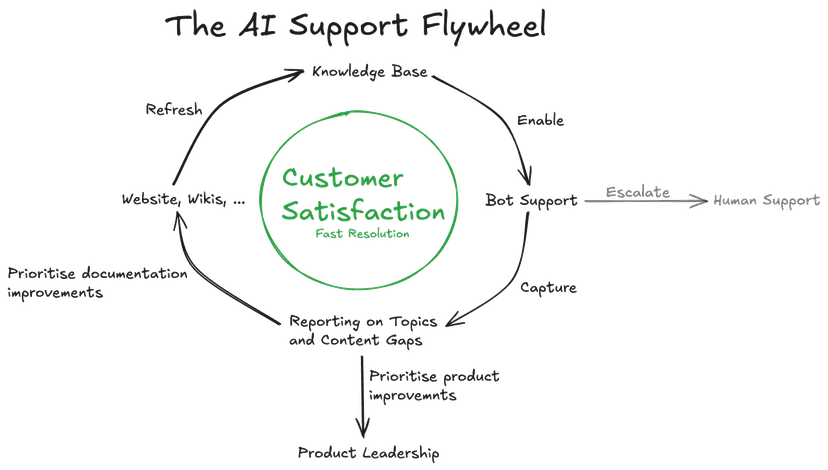
The AI Support Flywheel is based on one principle: The more customers interact through the AI channel, the more we learn, the better the AI gets, and the more customers use the channel. A self-reinforcing cycle.
But this flywheel has an Achilles' heel: Trust.
When a customer has a bad experience in chat, gets no solution, sees no handoff, and just ends up in a dead end, the following happens: The customer switches channels. They call. Write an email. Send a letter. And these interactions can't be analyzed by the AI, can't be learned from, can't be improved upon.
The flywheel stops.
Good escalations secure the feedback loop. They ensure that the customer stays in the channel, even if the AI couldn't help this time. Because they know: In the worst case, they'll still get help here quickly.
"But More Escalations Mean Less Deflection and Higher Costs?"
Yes, in the short term. But this calculation falls short. A customer we couldn't help will then contact support through other channels or move one step closer to churn. Among these alternatives, escalation is the best option.
Perfection from day one is an illusion. Anyone who thinks everything will work flawlessly from the start when adopting AI misjudges reality. Starting fast and learning fast is better than optimizing forever and never launching. The first weeks reveal which questions actually come in, which knowledge gaps exist, and which processes are missing. You only get this knowledge in live operation.
What matters is: The autonomy rate increases over time. Every escalation provides data. Every knowledge gap that becomes visible can be closed. With each iteration, the AI resolves more cases independently. That's the core of the AI Support Flywheel: More interactions lead to better AI, better AI leads to higher automation, and higher automation reduces costs.
But this flywheel only spins when customers continue using the AI channel. And customers only use the channel when they know: If the AI can't help, I won't end up in a dead end. Escalation is therefore not a cost driver but the prerequisite for costs to decrease in the long run.
There's also a frequently overlooked point: Even if the AI works perfectly today, that doesn't mean it will work perfectly tomorrow. Support organizations are often the first place where changes in the business become visible. A new product, a changed policy, an unknown bug. The support team finds out first because customers ask first. The AI must be able to catch these new cases cleanly. And if it can't (yet), the escalation must work.
Otherwise, you lose users' trust. Not once, but permanently.
How We Implement Escalations
At botBrains, we distinguish between two escalation mechanisms:
Explicit Escalation: Initiated by the Customer
When the customer realizes that the AI can't help further, they can escalate at any time. The escalation path is clear and accessible without barriers. Here's what happens:
- Summarize the problem: The AI summarizes the customer's concern based on the entire conversation history.
- Collect relevant data: Order number, customer number, problem description. Everything the human agent needs is collected in advance.
- Send the escalation: From the chat, an escalation email is sent to support on the customer's behalf. The customer doesn't have to write anything themselves.
The customer states their concern, and we take care of the rest.
Implicit Escalation: Initiated by the AI
When the AI recognizes that it can't provide a reliable answer, whether due to missing information, high uncertainty, or emotional frustration from the customer, it escalates proactively. Without the customer having to ask.
This is crucial: The AI should not try to get by with half-baked answers. Better to escalate once too early than once too late.
What We Observe
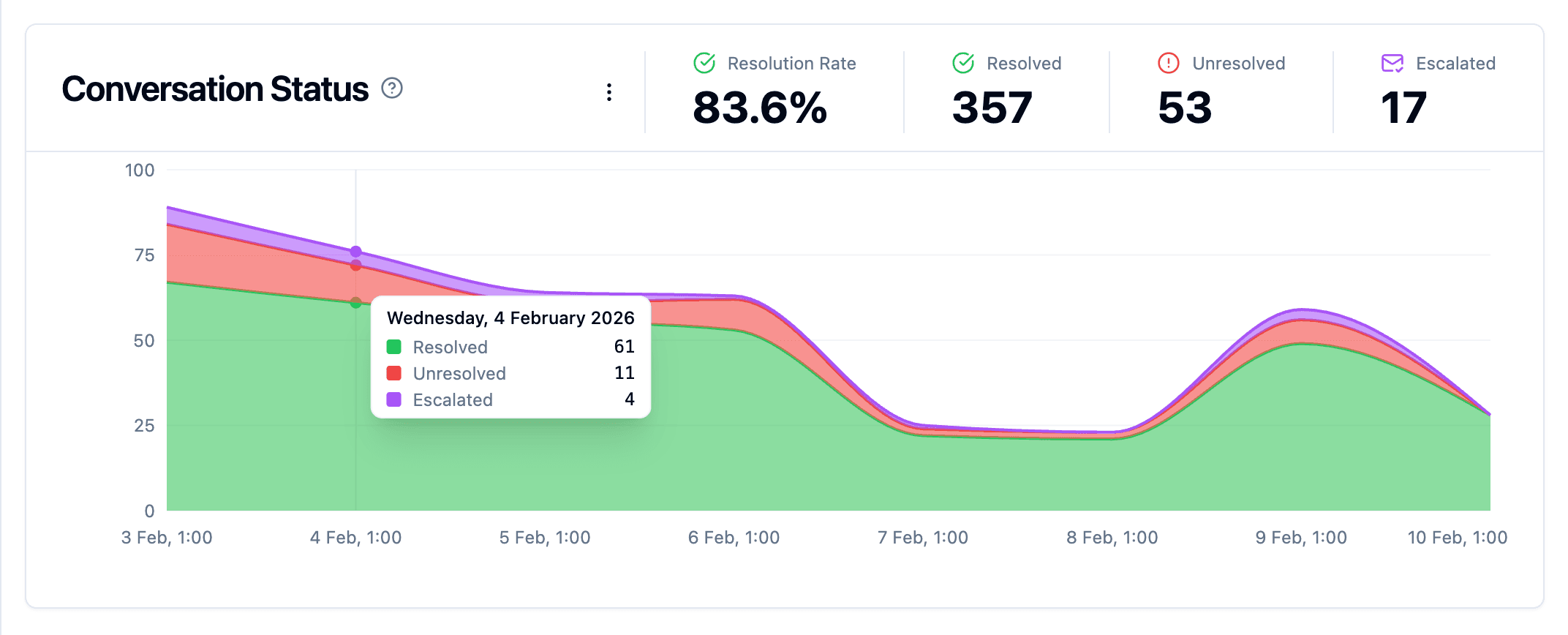
And this is where it gets really interesting: In our data, we see a high correlation between high CSAT and handoffs.
At first glance surprising, at second glance completely logical.
Customers simply don't expect the AI to draft their email to support. That the problem gets summarized. That all relevant information is already prepared. It's one of those wow moments in support. The customer just wanted help and gets more than expected.
This moment creates trust. And trust creates return visits.
The Customer Contract
Our position on escalations can be summarized in one sentence:
Fast, good answers through AI. And if that's not possible: an immediate, seamless transition to a human, without detours.
AI in support is not an either-or. It's a system where humans and machines work together. Escalations are not the admission that the AI has failed. They are the proof that the system works.
Only the best AI platforms understand this. They don't build escalations as a stopgap but as an integral part of their product. We've understood this and that's why we get to support many large customer service teams in the DACH region.