How botBrains Thinks About the Agentic Future in 2026
Customer service is becoming a product. Those who invest once in knowledge and processes automate permanently. AI does not just cut costs, AI is the better customer experience.

Liam van der Viven
Co-Founder & CEO at botBrains
Customer service is changing. There are many questions in the air. Some stem from fear, some from curiosity, some from a desire for transformation. Some want to save their company money. Others want to reduce their own workload. And others are simply convinced that AI, on average, delivers the better customer experience.
A scene I keep seeing: customer service agents have two tabs open. One for the ticketing system, one for an AI agent that drafts responses for them.
The big questions are on the table. This article is our attempt to answer them honestly.
Will All Customer Service Jobs Disappear?
No. Based on everything I know today, I don't believe that.
There will always be tasks and failure modes that require cognitive judgment, personal accountability, and escalation authority. At some point, you need a human who is responsible, who can be fired, who makes the final call.
An example: a customer reports significant damage caused by a defective product. The case is legally complex, emotionally charged, and the decision sets a precedent for future cases. This requires a human who recognizes that this case cannot be handled by the book. Who brings in the right decision-makers. Who weighs whether a goodwill offer is cheaper in the long run than a lawsuit. No company will hand this risk to an automated system.
There's a deeper reason why certain decisions in large organizations ultimately fall to a VP or CEO: these people have the broadest context across the entire company. An individual employee typically focuses on their own area of responsibility. A leader simultaneously holds employees, customers, the market, competitors, funding position, cash flow, open deals, and PR in their head. This context comes from years of experience and is often not even digitally recorded.
The latest LLMs have intelligence and reasoning ability at PhD level. But we don't tap into that intelligence, because it can easily run 10+ euros per request. And even at 10 euros per request: we can't feed the AI the exact context an experienced leader carries. Most of it was never digitally captured.
Humans are good at recognizing which cases are truly dangerous and involving the right people with greater decision-making and strategic authority. That accounts for the last 10% of volume. 100% AI automation won't happen.
However, existing teams will be able to double their output through the use of AI agents. It's also quite likely that some teams will stop hiring over time because AI has picked up enough slack. Outright layoffs are still rare, especially since natural attrition is sufficient and German labor laws and works councils act as inhibitors.
Why AI Still Doesn't Work Everywhere Today
Most teams in 2026 still have few autonomous AI solutions in use. And the truth is: for AI to work well, you usually need to document knowledge, simplify processes, and connect the right systems. Most platforms fail at system integration. Other companies struggle to pull one of their experienced employees out of daily operations for a day so they can review the automatically generated knowledge base entries from past conversations.
It reminds me of the fisherman parable: a fisherman who catches exactly one fish every day and eats it immediately will never build surplus. He has to go hungry for one day to build a second rod. Starting the next day, he catches two fish. He eats one, he saves the other.
It's the same with AI in customer service. You need to free up an experienced employee for a day so they can prepare knowledge and document processes. The result: a question that has been answered once never needs to be answered by a human again.
And this doesn't just apply to your own AI agent. Proper documentation makes knowledge discoverable for every AI: AI Overviews, ChatGPT, Claude, Perplexity. Those who structure their knowledge benefit across all channels.
The Real Driver: Customer Effort, Not Empathy
The main driver in customer service is not human empathy.
I know many empathetic people. I love calling them for a chat. But that happens in my free time, and I usually don't buy anything from them either. Customer service should be empathetic, but empathy is not the reason for the call. I call customer service because I need to get something done. The best predictor of customer satisfaction and loyalty is how easy it is to resolve my problem.
Research confirms this. The book The Effortless Experience shows: delighting customers succeeds in only 16% of support interactions. What really destroys loyalty is not the absence of wow moments. It's bad, cumbersome interactions. So the real question is: how easy does a company make it to resolve the customer's issue?
Example: High Effort vs. Delight Moment
A typical bad experience:
A customer has a problem with their credit card statement and calls support. Instead of a quick resolution, the following happens:
- They have to explain their issue multiple times because they keep getting transferred
- Different agents give contradictory information
- They're asked to fill out an additional form online
- After that, they're told to call back to check the status
In the end, the problem is solved, but the effort for the customer was enormous. It's not the absence of a wow experience that frustrates the customer, but the unnecessary effort they have to go through.
A typical delight moment:
A customer loses their credit card abroad and calls their bank. The agent is extremely empathetic, blocks the card immediately, sends a replacement card via express to the hotel, and proactively waives all replacement fees. They also explain how the customer can withdraw cash at nearby partner banks or find the most trustworthy exchange offices in the area as a stopgap. A strong service experience.
Why does this still have less impact than a bad experience?
Such delight moments are rare, situational, and don't reduce structural effort. In contrast, bad experiences work systematically: long wait times on every contact, complicated processes for every address change, repeated identification, channel switches, transfers.
A single positive wow moment doesn't offset the baseline friction. Multiple small points of friction in everyday interactions add up and shape perception permanently.
And this is precisely where AI excels.
Two Areas Where AI Shines
Customer Portals and Structured Flows
Return portals, self-service flows, address changes, cancellations. Wherever customers make structured inputs and clear logic applies, digital portals are superior to the phone.
Data entry over the phone is simply unusable. My credit card number? I don't know it by heart. My customer number? No idea. Authenticate myself? Just let me be logged in. Being logged in on the phone? Not possible. But in chat, in the portal, in the app, Chrome Autofill or the password manager can prefill. The system already knows my data.
Agentic coding will be a game-changer here. Companies can build more flows faster and cover more use cases without months-long development cycles.
Conversational AI
Conversational AI is the universal entry point: the customer describes their issue and the AI responds directly, until it decides that a human handoff is needed. We've written about this: Escalations Are Our Most Important Feature.
Why does the AI respond? Because it's faster, simpler, less effort for the customer. An AI gives a personalized, detailed answer in seconds. No more 30 seconds of dead air on the phone while the human looks up information, reads customer histories, queries systems.
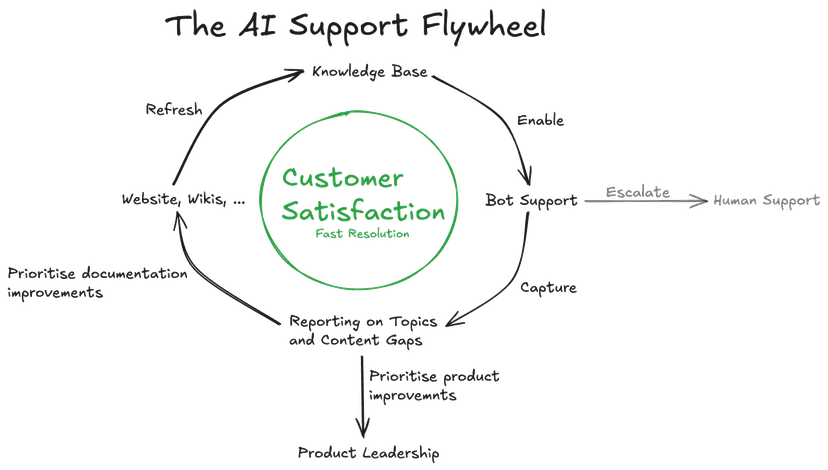
But: good experiences don't happen by themselves. Humans need to train the AI agents, think about channels, design processes.
The Shift: From Support Staff to Product Staff
The shift we're seeing: people are moving from support roles to product roles.
Customer service can be treated like a product. A new process is a new feature. Instead of onboarding new people over and over, with 30%+ attrition in call centers, you instruct the model, train it, verify the outputs.
Writing SOPs and documentation is the new core task. You become a manager of service processes executed by AI.
You write test suites for model outputs, evaluate behavior, and steer the model in the desired direction. Like giving feedback to an employee. Except the feedback sticks permanently and isn't forgotten after two weeks.
The key advantage: even when employees leave, the intelligence stays. The capability stays. Time invested once pays for itself within the month and saves customers and the company time for years to come.
The Common Thread
Three ideas run through everything we do at botBrains:
Less Customer Effort, Better Experience. Every decision we make is measured by whether it makes things easier for the customer.
Invest Today, Benefit Tomorrow. Like the fisherman who goes hungry for a day to build a second fishing rod. Those who document knowledge and structure processes today build lasting capacity.
Support Becomes Product. The future of customer service lies not in more staff, but in better systems steered by fewer, but more qualified people.
The agentic future is not a threat. It's a shift. From repetitive execution to strategic design. And we're building the tools for it.
Our customers show what this looks like in practice: Ballsportdirekt resolves 90% of inquiries automatically, skapetze supports 4,500+ customers with AI lighting consultation, FC Schalke 04 supports fans digitally with AI chatbot ERWIN, and OMR Education advises 1,000+ prospects with AI.